Quaker Indian Boarding Schools

Paula Palmer, a Quaker, describes what she learned about the Indian boarding schools. Following is an excerpt from her article, Quaker Indian Boarding Schools. Facing Our History and Ourselves in Friends Journal, October 1, 2016.


Last year I responded to a call that came from two sources: from Spirit, in the manner of Friends experiencing leadings, and from a coalition of Native American organizations that is working to bring about healing for Native people who still carry wounds from the Indian boarding schools.

My leading started with a nudge four years ago and grew into a ministry called Toward Right Relationship with Native Peoples. This ministry has grown in depth and breadth under the loving care of the Boulder (Colo.) Meeting. Working in partnership with Native American educators, I learned about their efforts to bring healing to the Native people, families, and communities that continue to suffer illness, despair, suicide, violence, and many forms of dysfunction that they trace to the Indian boarding school experience.

More than 100,000 Native children suffered the direct consequences of the federal government’s policy of forced assimilation by means of Indian boarding schools during the nineteenth and twentieth centuries. Their bereft parents, grandparents, siblings, and entire communities also suffered. As adults, when the former boarding school students had children, their children suffered, too. Now, through painful testimony and scientific research, we know how trauma can be passed from generation to generation. The multigenerational trauma of the boarding school experience is an open wound in Native communities today.

Quaker Indian Boarding Schools. Facing Our History and Ourselves by Paula Palmer, Friends Journal, October 1, 2016
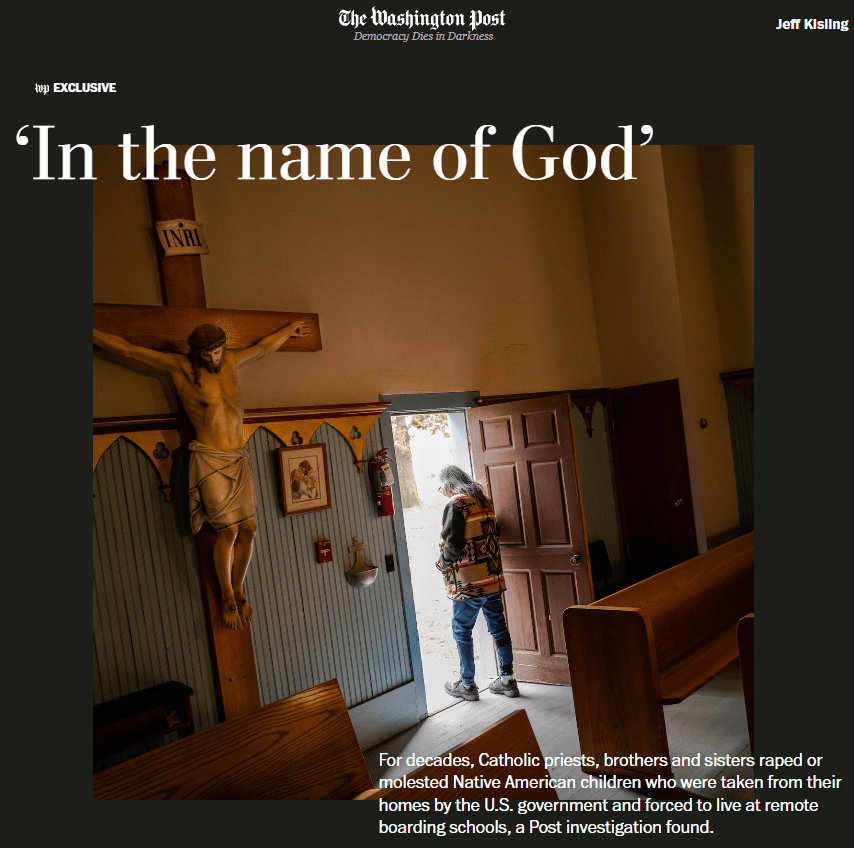

‘In the Name of God’

The Washington Post published the following two articles as interactive presentations of their investigation into sexual abuse in Native American boarding schools.

‘In the Name of God’ by Sari Horwitz, Dana Hedgpeth, Emmanuel Martinez, Scott Higham and Salwan Georges, The Washington Post, May 29, 2024

https://www.washingtonpost.com/investigations/interactive/2024/sexual-abuse-native-american-boarding-schools/


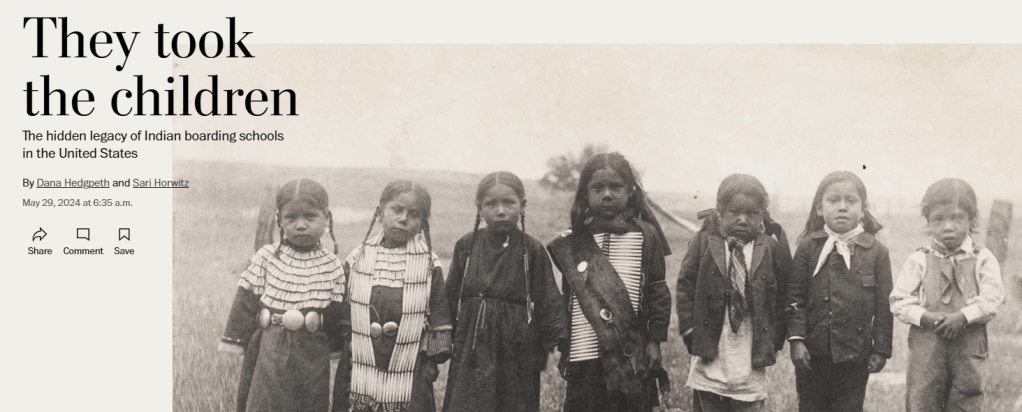
The second is an interactive presentation of their investigation into the history of those boarding schools.
They took the children, The hidden legacy of Indian boarding schools in the United States by Dana Hedgpeth and Sari Horwitz, The Washington Post, May 29, 2024

https://www.washingtonpost.com/investigations/interactive/2024/american-indian-boarding-schools-history-legacy

Deadman

Logan Staats’ beautiful new song, “Deadman” is another example of the power of art to call attention to injustice. The track comes alongside a visual accompaniment partially shot at the site of a former residential school.

Logan was beaten and arrested by the RCMP while supporting the Wet’suwet’en peoples. I was only peacefully singing our water song and hugging/protecting a 70-year-old matriarch. I was free’d and remain steadfast and committed to defending the land from sea to sea all across Turtle Island.

“I wrote ‘Deadman’ while in rehab. It’s not about a girl; the culture is the love that I’m asking for,” he revealed in a press release.

The love Staats pleads for in the song is not romantic but rather a demand for something cherished, stolen by settler colonialism. “The love for myself that was stolen from me — by the government, the crown, the church. When I sing ‘Give back my love,’ I’m speaking about my culture, my pride and my love for myself.”

As a descendent of residential school survivors, Staats delivers the single alongside a video partially shot on the property of the Mohawk Institute — a former residential school in Brantford, ON — and at Land Back Lane, where Six Nations land defenders have been fighting development on unceded Six Nations territory.

In a statement, Staats recalled fighting for land sovereignty alongside the land defenders in Wet’suwet’en territory:

Recently I’ve been spending a lot of time on the West Coast in Wet’suwet’en territory after answering the call of the Hereditary Chiefs there and standing in solidarity with the land defenders on their sovereign ground. After serving an eviction notice to Coastal Gas Link, a for-profit corporation conducting illegal activities on Wet’suwet’en territory, heavily armed RCMP officers were flown in and conducted a raid on the traditional lands or ‘Yin’tah’. During that raid I was punched in the ear, my head was slammed into the frozen pavement by my braids, and I was kneed in my spine and held down while I was handcuffed and bleeding… all after I was only peacefully singing our water song and hugging/protecting a 70-year-old matriarch. I was hauled off to jail along with my sister Layla Black, several other land defenders, elders; along with members of the press. With the support of my community and people rallying across nations, I was free’d and remain steadfast and committed to defending the land from sea to sea all across Turtle Island.

Logan Staats Announces Red Music Rising Debut with New Single “Deadman”. The track comes alongside a visual accompaniment partially shot at the site of a former residential school by Haley Bentham, exclaim.ca, Nov 25, 2021