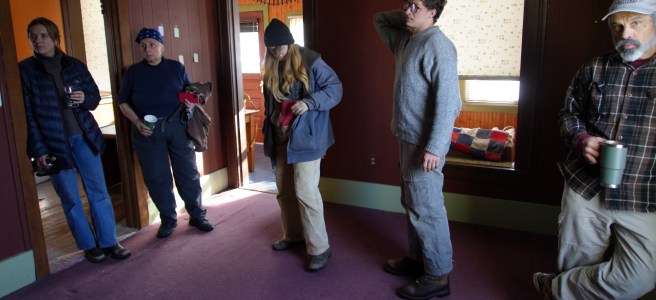
I arrived at Scattergood Friends School and Farm Sunday where I’ve been staying so I can go into nearby Iowa City to help with the beginnings of the renovation of the acre of land the Great Plains Action Society (GPAS) recently acquired, or would it be re-acquired? This is an example of the idea of LANDBACK, returning land to Indigenous sovereignty. The land was not voluntarily returned, but had to be purchased. Similar to the Meskwaki nation buying the land of their Settlement. 80 acres in Tama County, Iowa, was purchased on July 13, 1857, after Iowa passed a law in 1856 allowing them to live and buy land in the state.
Because of the significant snowfall, beginning work at GPAS was delayed a day for snow removal and the impact on travel plans.
That turned out to be a blessing, as I was able to spend the time at Scattergood. As I arrived students and staff were working on clearing the snow.
Sam Taylor has been my main contact at Scattergood. We talked a bit about the GPAS project, which he and the school have been connected with, including hosting people who were going to be working on the project this week. Besides me, Phil is also staying here. He had not been to Scattergood before. Sikowis and Sam have been having conversations about ways Scattergood students can be involved with GPAS’s work in Iowa City.
I haven’t been sleeping well at all, my mind on fire with memories of the years I spent at Scattergood (class of 1970). Reflecting on how every one of the main themes of my life found their beginnings there. Benefitting from the focus on developing critical thinking skills. And the continuation of experiences of living in Quaker faith based communities and having those experiences with people who became life long friends.
An interesting thing happened related to those times. Sam told me about a time capsule that had recently been discovered during construction in what had been the boys dorm, mentioning that I had written something there, which I had no memory of. When Sam showed it to me, almost every note was written by the boys in MY class! Scattergood planned to share the contents but hadn’t done anything with it, yet, so I volunteered to do so. I carefully unfolded each note, and took photos of each, and of the other objects in one of those cans Christmas cookies come in, and put them into a PowerPoint slide presentation, which I gave to Sam. I’ll only share the three things that related to me.


Students of the future, ban nuclear weapons! Jeff Kisling, Chairman, Atomic Energy Commission. I guess I had a little sense of humor then. In Junior high school I had developed an intense interest in nuclear energy, subatomic particles, etc, much to the chagrin of my parents when I kept receiving information from the Atomic Energy Commission in the mail. I planned to major in physics in college, but other things happened.

The other main themes of my life that began at Scattergood included learning how to work in the school’s darkroom, which also came in handy when I worked on the yearbook at Earlham College. One of the most popular things I did during my two years at the Friends Volunteer Service Mission in Indianapolis (after a year at Earlham College) was teach the neighborhood kids how to develop film and photos in the darkroom I would set up in the bathroom. I asked Friends to donate used 35 mm cameras, and we would ride our bicycles around Indianapolis taking photos.

My career in computer science also began at Scattergood. The late 1960s were early years in computing, with no personal computers as we know them. The University of Iowa gave free computer time to the area high schools. My math teacher at Scattergood suggested I buy the book, Learning FORTRAN, which I did, teaching myself the language. Each week I’d go into the University of Iowa computer center and punch the computer cards with my program, which was submitted to be run on the mainframe. Several hours later the stack of perforated computer paper would be available, usually with errors. A single typographical error would cause the program to crash. So I’d fix that, resubmit, and several hours later get those results, often containing other errors.
One of my main roles in the Infant Pulmonary Function Lab was designing the software systems that controlled and analyzed the research we did there. I began work in the lab in the early 1980s after several years of clinical experience in neonatal intensive care, and worked there the rest of my professional life. There were only half a dozen such research labs in the world, so there was no incentive for a company to develop pulmonary function testing systems for infants. That meant that each lab had to develop their own hardware and software systems. We were each focused on different things, so there was no opportunity to share these systems with each other.
Besides engineering the software systems, I also had to engineer the hardware to perform the studies,. Once again, Scattergood set me on another path. Don Laughlin, an Iowa Yearly Meeting (C) Quaker and friend found the funds to hire me to work in his medical electronics lab at the University of Iowa Hospitals during the summer prior to me Senior year at Scattergood. The hospital had just bought one of the first desktop computers and my job was to program it to automate the many complex calculations that had to be done manually to analyze patient’s pulmonary function tests. While there, he also taught me about medical electronics and how to solder components to circuit boards. That started my interest in medicine.
In our research lab at Riley Hospital, that experience was really helpful because I also had to discover the hardware needed to perform the testing we did on babies, and calculate and analyze the results. I soon became acquainted with the engineers at the Hans Rudolph company in Kansas City on a first name basis. They produced a wide range of respiratory medicine equipment which we used. But many of those components had to be re-engineered for us before we could use them for testing such small patients.
We had transducers to measure pressures, pneumotachs to measure flow and volume, a mass spectrometer to measure gas concentrations down to hundreds of a percent. All of which had to be calibrated prior to each test. Some of the signals had to be time shifted. Each instrument was read 100 times per second, and the results displayed in real time so we could monitor the testing.
This is from a very early version of our testing systems. The baby is mildly sedated with an oral sedative so they will tolerate have the mask on their face as show below.

The last software system we created took three years to develop, but in the end we became the only lab in the world that could measure the diffusion of gases in the infant lung.
As we learned more our research expanded to other, related fields. In the end we were working with researchers in maternal medicine doing basic science research related to cells from which the fetal circulation grew.


 Decolonial Repair Network